Free book · PDF · 130 pages
21 critical beginner mistakes in the Buteyko method What keeps you from increasing your control pause and getting results
An analysis of the most frequent mistakes made while mastering the method of Voluntary Elimination of Deep Breathing, and 121 answers to the questions beginners ask most often.
The book is free. The button will open a Telegram bot, which will send you the PDF.
Opened the site on a computer?Point your phone camera at the code, and the bot will open in Telegram.
- Author: Alik Mullakhmetov
- Format: PDF, A4
- Size: about 9.3 MB
- Year: 2026
- Help in creating it: Alenkiy Tsvetochek
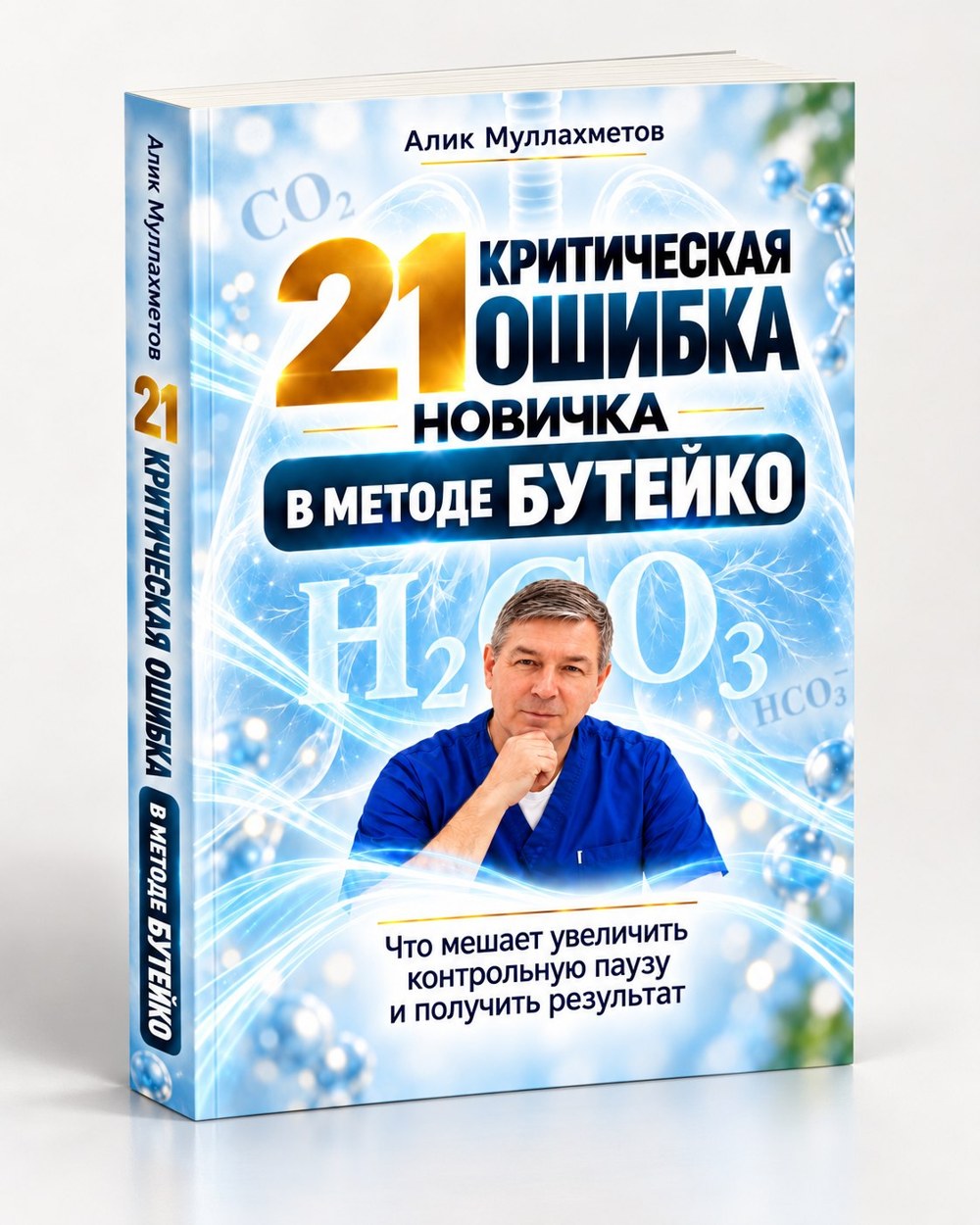
How to get the book
Three steps, less than a minute
- 1Click “Download the book in Telegram”Telegram will open with the bot. You need the Telegram app or web version.
- 2Press “Start” in the botThe bot will reply with a message and tell you what to do next.
- 3Receive the PDFThe book will arrive as a file right in the chat. Save it and read it on your phone or computer.
Video
Watch a video about the book
A video will appear here. For now you can watch it on the author’s YouTube channel.
Open the YouTube channelA familiar situation
You practice regularly, but your control pause does not grow
A person can practice for weeks and months without understanding why their readings do not improve. Most often the reason lies in details that are hard to notice on your own.
- They breathe less oftenInstead of reducing the depth of breathing, they start reducing its frequency.
- They stretch out breath holdsThey believe that the longer you endure, the better, and make breath holds the main exercise.
- They tense upInstead of relaxing, they clamp the breathing muscles, chest and abdomen.
- They measure the CP incorrectlyThey “squeeze out” the control pause by endurance or break into a deep inhalation.
- They keep changing exercisesThey look for “the most effective one” and do not carry the basic training through to a result.
The book teaches you to find such mistakes, understand their causes and correct your practice in time.
Mistake No. 2 from the book
The whole method fits on the fingers of your left hand
K. P. Buteyko suggested memorizing the essence of the method on five fingers. Beginners often remember the exercises but forget the principle for which they are done.
- 1reducing
- 2the depth
- 3of breathing
- 4by relaxing the diaphragm
- 5to an air shortage
A check for any exercise. If you doubt whether you are breathing correctly, ask yourself three questions:
Am I reducing precisely the depth of breathing? Is this happening through relaxation? Does the necessary sensation of air shortage appear?
What’s inside
Two parts: an analysis of mistakes and a reference section of 121 questions
The table of contents in the PDF is clickable: from it you can go straight to the chapter you need and return the same way.
21 critical beginner mistakes
- 1Learning the Buteyko method from videos on the Internetp. 16
- 2Not knowing the “left-hand rule” by heartp. 19
- 3Not studying the theory of the method and the basics of breathing physiologyp. 22
- 4Practicing the method without having experienced the deep-breathing test yourselfp. 25
- 5Considering breath holds the main exercise of the methodp. 28
- 6Trying to reduce the breathing rate instead of the depth of breathingp. 31
- 7Not tracking changes in the control pause before and after training and in the mornings once a weekp. 34
- 8Chasing growth of the control pause at any costp. 37
- 9Forgetting to tell yourself to relax when you feel an air shortagep. 40
- 10Not maintaining a slight feeling of air shortage throughout the whole training sessionp. 43
- 11Ignoring posture exercisesp. 47
- 12Not using special exercises to clear the nose when it is blockedp. 50
- 13Not paying attention to moisture and mucus in the nose during trainingp. 53
- 14Not using physical exercise while mastering the methodp. 55
- 15Ignoring mouth breathing during speechp. 58
- 16Overeating without taking into account that it is a strong factor that deepens breathingp. 61
- 17Not looking for your own factors that deepen breathing and not eliminating themp. 64
- 18Ignoring consultations with an instructorp. 67
- 19Ignoring cold conditioning and water proceduresp. 70
- 20Looking for new exercises when the current ones are already workingp. 73
- 21Not looking for a new exercise if the current one is not workingp. 76
121 popular questions and answers, 10 sections
- Understanding the method and trainingp. 80
- Control pause and assessing the resultp. 83
- Relaxation, attention and a comfortable positionp. 88
- Breathing in everyday activities and speechp. 94
- Movement, walking and physical exercisep. 96
- Exercises, rhythms and fatiguep. 100
- Daily routine, regularity and recoveryp. 104
- Physiology of breathing and gas exchangep. 108
- Nutrition and monitoring your conditionp. 116
- Individual conditions, safety and limitationsp. 119
Take a look inside
This is what the book’s pages look like
Diagrams, illustrations and lively language. Click a page to view it larger.
P. 19. Mistake No. 2: the left-hand rule P. 28. Mistake No. 5: a breath hold is a tool, not the essence of the method P. 11. Introduction: the author’s path to the method
The Buteyko method is not a collection of breathing exercises. It is a system.
Changes happen not because you have watched many videos. They happen when you correctly and regularly carry out what you have already understood.
Who it is for
Who will find the book useful
- BeginnersIt will help form a correct idea of the method and avoid typical mistakes from the very first sessions.
- Those who already practice VEDBIt will let you analyze your own sessions and better understand how your control pause changes.
- People studying breathing techniques on their ownIt will explain how breathing exercises, breath holds and the Buteyko method differ.
- Instructors and teachersIt will serve as additional material for explaining frequent mistakes and answering students’ questions.
- People interested in the physiology of breathingIt introduces the regulation of lung ventilation, the role of carbon dioxide and self-observation.
Questions
The book in brief
How can I get the book?
Click the “Download the book in Telegram” button. The Telegram bot will open: press “Start”, and the bot will send the PDF right into the chat.
Is the book really free?
Yes. Downloading is free. The author permits copying and distributing the book, in whole or in part, in print and electronic form, provided that the author’s name and the title of the book are stated.
Is this a course with exercises?
No. It is a book about how to avoid typical mistakes: it explains the principles of the method and the physiology of breathing and answers frequently asked questions. The author recommends consultations with a trained instructor, because mistakes are easier to see from the outside.
Is the book suitable if I am just starting?
Yes. The first part is written for beginners, and the reference section of 121 questions is handy to open as you practice.
May I translate and retell the book?
Yes, you may translate, abridge and rework it. You must state the author and the title of the book and mark the changes made.
Does the book replace a doctor’s consultation?
No. The book is educational and contains no diagnoses or prescriptions. See the safety section below for details.
Important safety information
The book is intended for educational and informational purposes. It does not replace examination, monitoring and treatment by qualified specialists.
- People with heart and vascular, respiratory, neurological and other chronic diseases, as well as pregnant women, need to talk to their treating doctor before practicing.
- In case of dizziness, feeling faint or a noticeable worsening of how you feel, the exercise must be stopped.
- In case of chest pain, pronounced difficulty breathing or loss of consciousness, you must call an ambulance immediately.
- Breath holds must not be performed in water, while driving or in any situation where a possible loss of consciousness is dangerous.
- Information from the book is not grounds for stopping medicines, changing dosages or refusing prescribed treatment.
The body’s response to breathing exercises is individual. The author does not guarantee any particular therapeutic or health results.
Do not repeat the mistakes that hundreds of people have already made
Download the book and check your practice against it. It will take one evening, and you can start noticing your mistakes in the very first chapters.
Download the book in Telegram